
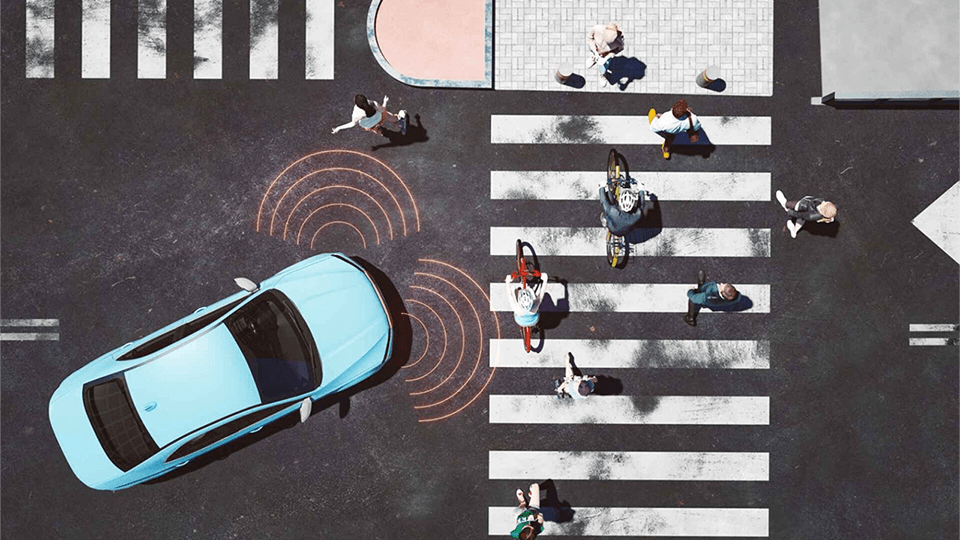

Higher-Level Vision: Understanding, Not Just Seeing
Once features are extracted, computers can perform different tasks:
- Classification: “What is in this image?”
- Detection: “Where are the objects?”
- Segmentation: “Which pixels belong to what?”
- Pose estimation: “How is the body oriented?”
- Tracking: “Where is this thing moving?”
- 3D reasoning: “What is the structure of this room?”
At this point, computers are not just seeing.
They’re perceiving.
They can answer more complex questions:
- What is happening?
- What should I do?
- How should I react?
This is the leap from pixels to perception.
Real-World Applications: Vision at Work
Computer vision is everywhere, often silently:
- Self-driving cars detect pedestrians, lanes, and traffic lights
- Medical imaging systems highlight tumors and other anomalies
- Industrial quality control checks for defects
- AR and VR systems interpret your room’s geometry
- Security cameras recognize motion or identify faces
- Smartphones analyze scenes to auto-optimize photos
Why Seeing Is Hard (Even for Computers)
Despite all this progress, machine vision remains challenging.
Some classic obstacles:
- Dramatic lighting changes
- Shadows, reflections, and glare
- Occlusion (one object covering another)
- Unusual perspectives
- Variations in shape or appearance
- Situations not found in training data
These are all scenarios we can handle effortlessly.
Computers?
Not always. Seeing is easy for biology, hard for algorithms.
The Future: Towards Machines That Perceive Like Us
Future progress aims to close the gap between how humans and computers understand the world:
- Models that learn with fewer examples
- Systems that handle messy, real-world environments robustly
- Vision combined with language and reasoning
- 3D understanding from cheap, common cameras
- Machines that can adapt to new scenarios without retraining
As these capabilities grow, “vision” transforms into something closer to machine perception, where computers don’t just see objects but grasp context and intention.
Closing Thought
When a computer looks at an image, it doesn’t see the world the way you do. It sees grids, numbers, gradients, and statistical relationships.
From these simple ingredients, it builds a surprisingly rich understanding of the world. The journey, from photons to meaning, is one of the great engineering achievements of our time.
It’s how machines see.
And it’s still evolving.